
I spent 2 weeks meeting with people who've been fighting on the front lines.

I’ll preface this newsletter by saying this:
Pay attention to the stories of people around the world who are trying to warn you of what might be down the road when it comes to digital surveillance and control. It’s by learning from the stories of those around us that we can better protect ourselves and get ready for the fight that is coming.
Now for an update.
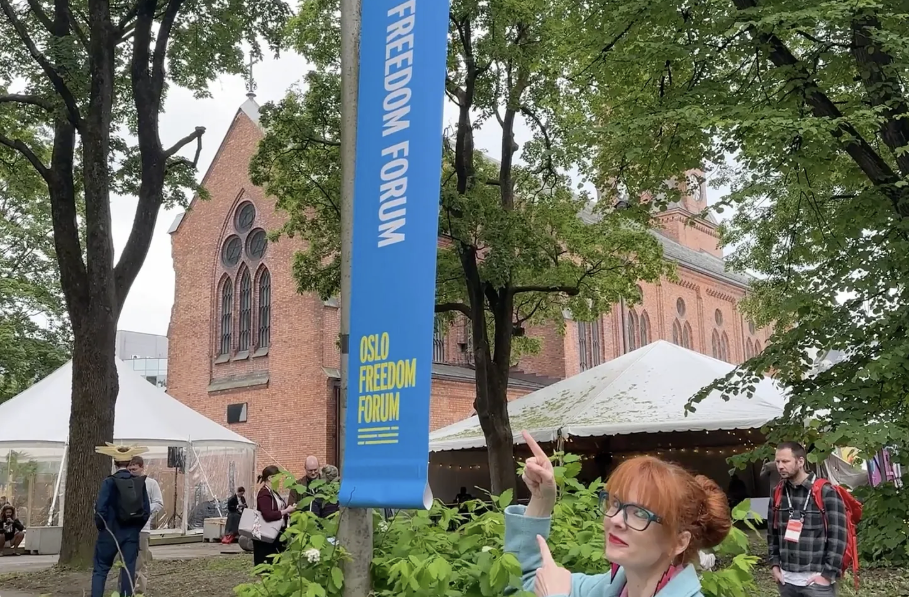
I just got back from two weeks in Europe, where I met with freedom activists from all over the world, hosted privacy workshops, and attended presentations from those fighting against tyranny and control. I talked one-on-one with people for whom privacy is a matter of life or death. I worked to understand the kinds of regimes they were up against and how they organized underground movements to educate people and push back, and I advised on privacy technologies that might help them protect themselves in their dangerous work.
It was an eye-opening experience, hearing from people living under some of the worst regimes in existence about the struggles they face. Even attending the conferences where we met could have been enough to get them sent to jail.
One of the presentations I saw was by Farida Nabourema, an activist from Togo. She explained that she grew up under a military regime, but that it took her a long, long time to understand that the regime itself was the enemy. When you’re surrounded by propaganda and that’s all you hear, you don’t quite realize that it’s propaganda.
“In the innocence of your childhood, you believe this is normal. Then one day everything changes for you. You feel so angry that for years you have been told a completely different story at school — that you have chanted, danced for, and praised a man responsible for such horror.”
— Farida Nabourema
It’s always easier to see the propaganda of other countries. It’s much harder to see propaganda in your own. It made me think hard about what I’m not noticing, or turning a blind eye to, where I live.
The Titanic Analogy
There was an interesting anecdote brought up at this conference about the Titanic. When it was sinking, people didn’t want to leave the ship. They didn’t believe that the Titanic could actually sink, and so lifeboats were leaving half empty. It wasn’t until it was too late that they all started clamoring to get on the remaining lifeboats and escape.
It’s a great analogy for what’s going on around much of the world right now. Many people who’ve grown up with a lot of freedom look at their country and say:
“Oh, this ship can never sink. We have so much freedom. It doesn’t matter if we give away our privacy rights, if we acquiesce to government ID mandates, if we allow censorship of certain views. We have so much freedom we can’t possibly lose it.”
But meeting those on the front lines of fighting tyranny, some of whom were shot multiple times trying to escape their country, was a reality check. It reminds us of how easily freedom can be lost.
I sat next to a woman at dinner who told me stories of her organization, and what she and her team need to do in order to stay safe while they try to bring change to their country. She explained how her country hadn’t always been under authoritarian rule. The current dictator first came to power campaigning on democracy and human rights. He was voted in through fair elections, but then slowly entrenched his power. He set up more systems of surveillance and control, began to censor dissent. He rewrote the constitution to build a powerful executive presidency and concentrated authority in himself. When the opposition party became too powerful, he found a reason to jail the leader. When the next opposition leader became too powerful, he replaced them with someone of his choosing.
The process of entrenching power can be slow, but there’s a tipping point where they can no longer be removed, and you can no longer push back.
Farida put it plainly in her speech:
“When you don’t grow up under dictatorship, you might think that the people who do are morally deficient, or that they lack courage. But the reality is that dictatorship is a system of engineered compliance.”
— Farida Nabourema
Engineered Compliance
When you’re on the outside looking in, you might wonder how a population became so compliant. If what those in power are trying to do is so egregious, why doesn’t the population just fight back?
“Engineered compliance” is a great way to put it. It’s when you train the population to put up with things by introducing them slowly. Introduce control not in one fell swoop, but little by little. Every new concession seems palatable by itself, especially when it’s framed as a moral argument.
“It’s for the good of the nation.”
“It’s to protect children.”
“We’re only going to use this against bad people. What have you got to be afraid of?”
You’re taught not to push back, and silenced when you speak out.
“For daring to oppose the regime, you find yourself persecuted. They do not just make sure that you, the dissidents, pay for your disobedience — they make sure that your entire community pays for it. And of course, what was expected of me from those friends and relatives and family members is that I give up and become silent.”
— Farida Nabourema
What Are The Red Flags?
It’s sobering to meet people across the world who are fighting under horrendous circumstances, and to learn from their stories. They show us why privacy is so important to them, how it protects them, so that we might understand its value where we live and not take it for granted. We can also learn from them what the red flags were, the ones they wish they’d recognized before it was too late.
It should motivate us to look at what’s going on around us and ask: what similar red flags do I see here? Where am I being stripped of rights? Is it possible I’m being silenced or controlled?
One of the red flags for me is absolutely the entrenchment of the surveillance state.
Because when we get to a point where we can no longer communicate privately, meet privately, make transactions privately, support political causes privately, or travel through our city without being tracked by cameras, that’s a huge issue.
We will end up in a situation where tyranny takes hold, and by the time we wake up to that fact, we’ve lost all of the tools that used to be at our disposal to push back. We’ve lost the self-correcting mechanisms that used to allow us to shine light on abuse of power:
Maybe we no longer have whistleblowers, because surveillance has become so pervasive that people can no longer speak out safely. Maybe we lose investigative journalists for the same reason. Maybe protest movements dry up because it becomes so easy to identify and silence them in advance. Maybe we lose opposition party members because it becomes too dangerous. Or perhaps it just becomes easy enough to sway the population itself, using digital algorithms to convince people of things that aren’t true, to make them hate certain groups by persuading them those groups hate them.
Digital freedom and digital control aren’t a binary; they’re two ends of a spectrum. Where are we on it right now?
What Is The State Of Global Digital Control?
We have never seen so much authoritarian control in the digital space. We have government ID mandates being forced on us that will act as permission slips just to browse the web. We have device attestation being pushed, where you will only be able to access certain apps and websites from approved Android and Apple operating systems. We have VPN bans, communication backdoor mandates, and the arrest of privacy tool developers.
This didn’t happen all at once. We’ve been frogs in boiling water. We’ve slowly voted away all the privacy we took for granted, or just let it get taken from us without putting up a fight.
The internet started out as a wonderful promise of freedom. A promise of information shared without gatekeepers. Of people connecting across the world without interference. But over time, it slowly became something very different
Much of what made it great is still there. But the internet has also become one of the most potent tools for totalitarian surveillance and control we’ve ever seen. It became trivial to monitor people, easier than ever to manipulate them, and simpler than ever to censor them. And most of the mechanisms that allow this control operate largely unseen.
If someone wants to entrench their power in this landscape, they have all the tools they need. They have an entire surveillance apparatus at their disposal to surveil and control behavior.
“In my country, Togo, people have been arrested, prosecuted, and jailed for years simply because they contributed financially to the resistance. One of those people I met in person for the first time yesterday, after he had spent eight years in prison.”
— Farida Nabourema
It’s easy to feel hopeless, but we’re not so far along the spectrum that we can’t fight back. The first step is to notice the forces of control that have crept in without us realizing.
Many of the people I spoke to found it really difficult to communicate and organize safely because all the communication platforms they use are surveilled, and downloading alternatives could flag them to the authorities. There were communities that couldn’t get the word out about what was happening inside their country because the internet had been shut down. They wanted to access mesh networking tools, but with the economy closed off, it was harder than ever to smuggle in the hardware needed to set them up.
Those conversations are what preoccupy me most right now, and they keep pulling me back to a single question:
What technologies do we need to create, proliferate, and normalize right now to make sure we safeguard our freedoms in the future?
I never want to get to the point where we can no longer protest or speak truth to power. So it’s become more important to me than ever to identify all the centralized control points of the modern digital world and build an underground railroad of alternatives we can rely on no matter what happens politically. If your digital freedom survives only when a good person is in power, that’s not a robust strategy. It needs to be resilient no matter who is in power.

So What Do We Do?
Much of the world is at an inflection point right now, where we’re being asked to give up our digital rights. We’re told, “Oh, it’s for the children,” or “It’s to fight against terrorism,” or “privacy is just for criminals, what have you got to hide?”
But we need to be far more vigilant. We can’t just accept these narratives at face value. We need to realize that this is the same technique used by countless authoritarian regimes throughout history: making a moral argument for why we should be okay with giving up our rights.
There’s a “Bootleggers and Baptists” dynamic here. Such propaganda is often manufactured by those looking to consolidate control over things like the digital world and the financial sphere, but then parroted by those with good intentions who haven’t thought hard enough about the downstream consequences.
If individuals don’t protect their freedom and privacy in those spaces, it becomes very easy for entrenched power to dig in even deeper. We should not allow ourselves to be conditioned to believe the propaganda that privacy is a tool for criminals.
Privacy is the foundation of a free society. We have to fight for it.
The great news is that we still have the ability to fight back. But we may not in a couple of years. We might have an internet with so much surveillance baked into it that we can no longer challenge bad laws, try to get these politicians voted out, or show dissent. Countries we once would have called very free are already arresting people for what they say on social media. Look at the systems being built to censor people and to monitor their transactions, their movements, and who they’re associating with. That’s why we have to push back while we still can.
The advent of AI means things are going to get very different, very fast. By the time we decide we want to leave the boat, it will be too late.
Maybe we’re lucky and things never actually hit that tipping point. But we shouldn’t leave it up to chance. We should fortify the institutions, the tooling, and the community building that will help us be resilient if it were to happen.
The people trying to warn you about what’s down the road aren’t describing some distant, foreign problem. The whole globe is moving along the same trajectory when it comes to digital control, and they are simply further down it than we are.
It’s by learning from the stories of those around us that we can better protect ourselves and get ready for the fight that is coming.
“Dictatorship is not a permanent system. It is a constructed one. But the beauty of what is constructed is that it can also be dismantled — through the courage of those who refuse to abide by the rules of the oppressors. And we are only just getting started.”
— Farida Nabourema
Yours In Privacy,
Naomi
Consider supporting our nonprofit so that we can fund more research into the surveillance baked into our everyday tech. We want to educate as many people as possible about what’s going on, and help write a better future. Visit LudlowInstitute.org/donate to set up a monthly, tax-deductible donation.
NBTV. Because Privacy Matters.