
Are Warrants Optional Now?
It’s that time of the year again. When we vote to extend the warrantless mass surveillance of FISA Section 702, and collectively pretend that this temporary power is, again, only going to be temporary.
So it’s a great time to discuss the importance of warrants.
I understand the argument for eliminating warrants — when a threat seems so big, you don’t want any friction like warrants slowing you down.
But what about when there are even bigger threats that no one talks about, and warrants are one of the most critical safeguards that protects us against these threats?
Most people have never spent even five seconds thinking about warrants, and this is a big mistake, because if we allow the dodging of warrants to become normalized, as it has been under Section 702, we’re in big trouble.
In this article, we’ll explore what warrants are, why the founders cared so much about them, and why they matter more now than ever, in an age where governments are buying all your data from brokers, contracting with private companies to track your movements, and bulk collecting all your financial records.
It’s a new digital era, and the protections warrants were meant to provide have been all but eradicated. So stick with me. Because once you understand the machinery inside a warrant, you will never dismiss the importance of them again.

What Is A Warrant?
Let’s start by understanding what a warrant actually is.
They sound legal. Procedural. People think warrants are just about paperwork. But they’re not.
Warrants are one of the most important checks on power ever invented. And there’s a certain part of the warrant that almost no one ever talks about, even though it’s the part that matters most. We’ll get to that.
For now, understand that warrants have existed in legal systems around the world for a long time. They’re basically a permission slip for the government to search your stuff, seize property, or arrest someone. They vary enormously from country to country in how broad they are. In America, for example, they’re meant to be particularly limited, and these strict limits were actually explicitly written into the Constitution itself.
This is because, at the time that the Constitution was written, Britain and colonial America had been badly abusing warrants. Officials were using two types of broad search powers in the early colonial days called General Warrants and Writs of Assistance, which enabled officers to rummage through a person’s home and things with very little constraint.
As Rob Frommer, senior attorney and co-director of the 4th Amendment Project at the Institute for Justice, explained to me,
“There were these pieces of paper that officials would basically write to themselves, and they would just carry that in their pocket. That would give them power to just enter people’s homes, enter people’s property, invade them whenever they wanted. It let those petty officers be a law unto themselves where they could break in anywhere they wanted to at any time, without any real justification.”

This broad search power became a powerful tool for harassment and abuse. In England, for example, these were used to suppress dissent. People who would criticize the crown and officials in the British government were targeted. Officials would use their general warrant powers to break into homes, to try to find seditious materials. This is one of the big reasons America had a revolution.
So when the founders were writing America’s Constitution, to stop this kind of abuse from happening again, they decided that warrants had to be tightly limited in scope. So they drafted the Fourth Amendment:
“The right of the people to be secure in their persons, houses, papers, and effects, against unreasonable searches and seizures, shall not be violated, and no Warrants shall issue, but upon probable cause, supported by Oath or affirmation, and particularly describing the place to be searched, and the persons or things to be seized.”
This was added to the Constitution in the Bill of Rights to protect against general warrants. The lesson was clear: the power to conduct broad searches of the populations leads to abuse.
Warrant Requirements Under The Fourth Amendment:
A specific place
Specific people or things
Probable cause
Sworn facts
Judicial approval
That narrowness mattered, because it meant that those in power could no longer go on fishing expeditions, searching your things until they found something they could use against you.
It also created accountability, because it left a record. Abuse is much harder to challenge when there is no paper trail and no one ever had to justify themselves in the first place.
The Most Under-Appreciated Part Of The Warrant
Let’s zoom in on one of the most overlooked parts of the warrant requirement, and one of the most important:
An investigator has to make their case in front of a judge, and prove that they had probable cause before a search is allowed to happen.
The reason the framers required the involvement of a second branch of government, the judiciary, is because law enforcement has been trusted with the immense and unique power to use force against citizens, so checks on this power are necessary. You want an independent, neutral branch looking at search, seizure, and arrest decisions before they happen, to decide whether there are enough facts to actually justify it.
We’re so used to treating law enforcement as the highest authority for keeping law and order that we forget that the Constitution treated it as just one power center among others, and one that needed limits. Those who wrote the Constitution understood that law enforcement has its own mission, its own incentives, its own momentum. It is trying to solve cases and find culprits.
This doesn’t make investigators evil, but it does mean they are not neutral.
Once you realize this, the warrant requirement no longer seems like bureaucratic paperwork. It becomes clear that it’s a very deliberate safeguard against the natural bias of the investigative process.
In fact, in 1948, The Supreme Court put it bluntly when they said:
“Its protection consists in requiring that those inferences be drawn by a neutral and detached magistrate instead of being judged by the officer engaged in the often competitive enterprise of ferreting out crime.”
- Johnson v. United States, 333 U.S. 10 (1948)
As Frommer articulated:
“They’re really eager, because if they make a big bust, that’s great for their career. So they’re gung-ho. And we want somebody in the middle, saying, ‘Wait a second, show me that you actually have a good reason to do this and not just because you’re seeing promotions and awards in your eyes.”
The people who wrote the Constitution didn’t assume that the same people trying to solve the case should also be trusted to decide, on their own, how far they should get to pry into someone’s life. They assumed the opposite -- that the drive to solve a case could itself become dangerous if no outside check stood in the way.
When executive officials get to make these decisions with no independent checks, abuses mount. This is why a neutral magistrate authorizing searches in advance is essential. And when this safeguard is ignored, abuses tend to happen more and more.
This is the forgotten danger that not enough people are talking about in the current Section 702 debate.
Where did these checks on power go?
That is why the executive and judicial branches have different jobs.
The executive branch is in the business of investigating crime. The judicial branch is meant to stand back from the momentum of investigation and make sure the government does not get to decide the limits of its own power. That separation is intentional.
The judiciary is supposed to be there as the bulwark of our rights. But today, the judiciary is conspicuously absent from signing off on a huge number of searches that are going on. Investigators are buying giant data sets from brokers, and searching this data at will. They have unfettered access to troves of personal data about our lives, with no magistrate involved. And the data they have access to gets bigger and bigger over time.
Why Is A Search Dangerous?
Let’s answer the obvious question: So what?
What is so dangerous about these searches that we built constitutional limits around them in the first place?
The real issue is not the search itself. It is the power that comes from this kind of access.
Information is power, and the Fourth Amendment was designed to limit the government’s access to information about you -- to limit the amount of power it had over you, and to make sure that power did not turn into abuse.
If a government can look through your life in enough detail, it can always find something that can be made to look suspicious, something that can be distorted, or something it can use as leverage.

Once the government gets enough access to the fragments of your life, those fragments become easy to rearrange into a narrative. You can easily cobble together a story that makes someone look dangerous, suspicious, or worthy of investigation.
You were near the wrong place.
You searched for the wrong thing.
You texted the wrong joke.
You donated to the wrong cause.
Maybe you used encryption.
Turned your phone off.
Showed up in someone’s contact list.
None of that has to mean guilt. But modern life produces so much data that innocence alone can no longer protect you.
If officials decide in advance whom they want to target, and they have access to a giant trove of someone’s life, they can often easily find scraps of evidence to fit the narrative.
Again, this does not require evil motives. It can happen simply because investigators are doing what investigators do: trying to connect dots. But once someone is looking for a culprit, the temptation is to treat scattered clues as if they all point in one direction. Out-of-context fragments of your life start to look suspicious because they are being viewed through the lens of suspicion by someone trained to do just that.
And now we are increasingly outsourcing that process to AI, again with no magistrate involved. When we let masses of data generate their own “story,” innocent people get swept up in the dragnet. Data is not benign. It can always be sorted, weighted, and interpreted in ways that make ordinary life look incriminating.
Frommer explained how the investigative process has its own bias:
“We often see officers get an idea in their head, “This is what happened.” And then instead of trying to do a neutral investigation in order to determine what objectively happened, they start backfilling, and contorting facts to fit their preexisting narrative. That’s exactly why you want to have that neutral judge in the middle, for an independent check.”
So far, we’ve been talking about how this power can become dangerous even in the hands of people who think they’re doing the right thing. But what about people with worse motives? Once the machinery exists, it doesn’t stay confined to good-faith mistakes.
And the elephant in the room is that the more data someone has access to, the more power they have. Feed these systems enough data, and they gain a greater ability to sort people, rank people, and decide who gets more scrutiny.
This is how discretionary targeting begins. It can identify whistleblowers. It can chill journalists. It can map protest networks before they become effective. It can scare ordinary people away from joining, donating, speaking, meeting, or pushing back against the people in charge.
Once this infrastructure exists, using this power is a huge temptation, even for the most well-meaning people. You’re basically hoping that no one ever gets into office who might abuse this power. And if they do, they now have a ready-made system for intimidating dissidents, finding leverage over political opponents, and entrenching their own power.
Jim Harper, a constitutional law scholar at AEI who specializes in the Fourth Amendment and how it applies in the digital age, explained that the reason we have these checks is to protect our democratic institutions. If we fail to do this:
“Having a government where the wheels come off of and our protections fall away -- we’re going to really need our privacy then.”
The Government Is Buying Your Data
Unfortunately today, it’s almost like we’ve forgotten about the Fourth Amendment. Perhaps because the Constitution seems old and outdated to some people. But not only are these protections still relevant, they’re more important than ever. Because today’s government can access a staggering flood of information compared with anything the founders could have imagined.
Every part of our life is digitally archived in data logs, telemetry, search history, prompt archives, location records, and maps of your social graph. Your data has already been collected, by myriad companies archiving every aspect of your life.
Your bank has your transactions.
Your phone company has your location.
Your email provider stores your messages.
Your cloud account holds your files.
Your apps know where you go, what you search, what you buy, who you talk to, and what patterns your life follows.
We have multi-billion-dollar industries that have emerged to surveil us.
And apparently this data is completely up for grabs, with no judge getting in the way. There’s a huge amount of investigative activity that should require a warrant that doesn’t get it. Many agencies act as if a warrant is just the key that forces someone to hand over data. And if they don’t need the key and can just buy the data instead, why bother with the warrant?
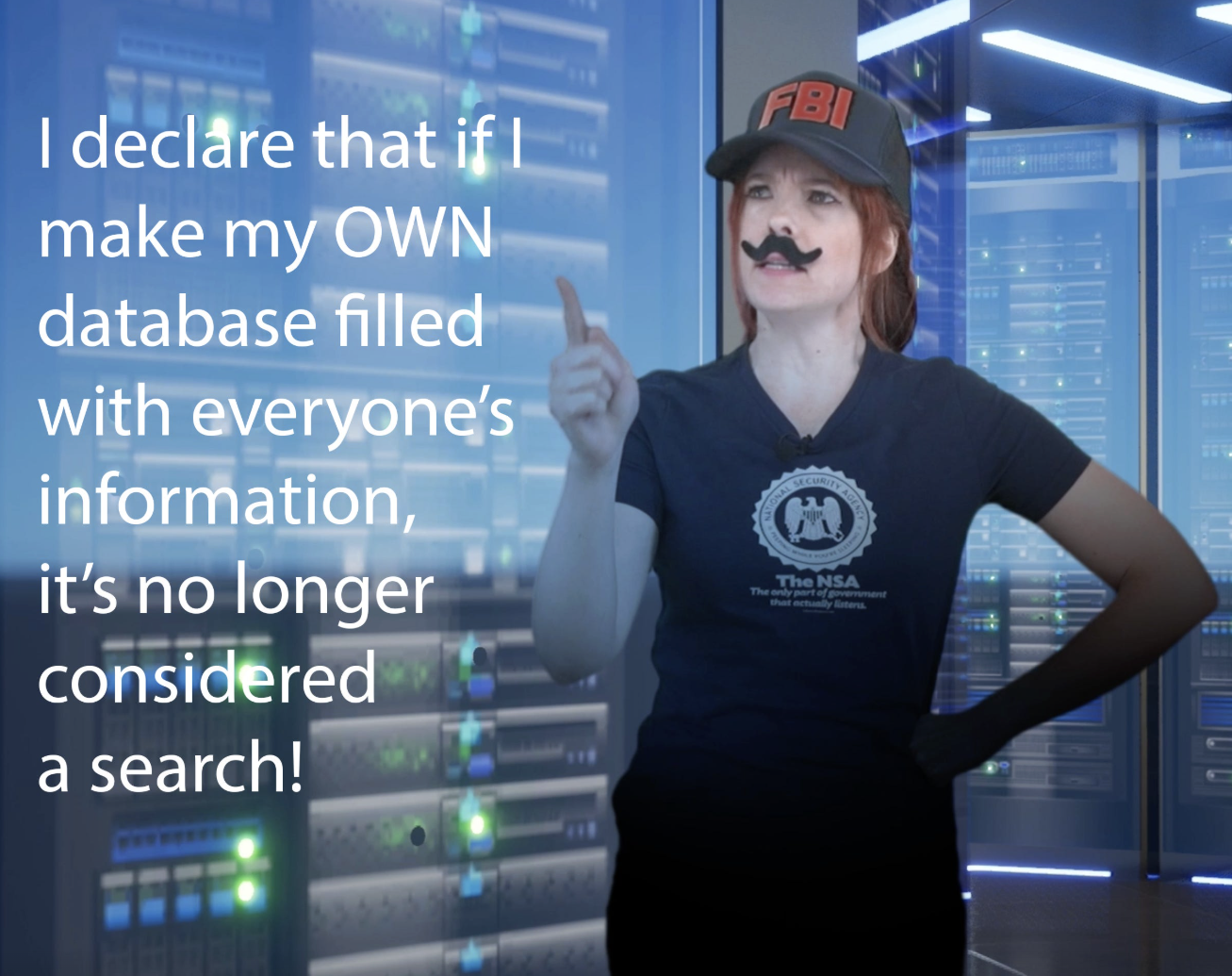
This misses the deeper point. The Fourth Amendment says no unreasonable searches. We can’t just allow law enforcement to redefine the term “search” to exclude wide swaths of activity they’re engaging in, such as purchasing datasets that they then search, because they want to avoid warrant requirements.
This week a major bombshell dropped (which wasn’t even the bombshell it should have been because everyone knew this was going on) that the FBI is buying your data.
Wyden: “Can you commit this morning to not buying Americans location data?”
Patel: “The FBI uses all tools … to do our mission. We do purchase commercially available information that’s consistent with the Constitution and the laws under the electronic communications privacy act.”
As Harper notes:
“They’re rummaging your things. They just happen to be digital things that are held remotely for you.”
And so often with these searches and warrantless subpoenas, the obvious question is:
“Why couldn’t you have gone to a judge? If you have such a case against this person, why can’t you go and get a warrant?”
The dirty secret is that the vast majority of times, if the government went and applied for a warrant, they’d probably get it. But they don’t see warrants as a critical check on power, they see it as busywork.
As Harper explains:
“Warrant applications involve some work. Maybe it’s an hour. If you’re good at it, it’s half an hour. But it requires law enforcement to think carefully about and articulate their cases. Unfortunately there’s an ongoing tension, and law enforcement is constantly pushing to lower the warrant requirement. They really do want to catch criminals, but I think they want to make it so easy, that it’s subject to abuse. And obviously, with the huge swelling of information that’s online and in third-party hands, our privacy is undermined deeply by this resistance to using warrants to get information, when they properly should.”
Frommer added:
“The idea that my location information -- all the routes I’ve driven, all the places I’ve gone -- is sitting in a government database that any officer can look up whenever they want… that undermines my security.”
The whole point of the warrant requirement is to slow investigators down, force them to justify themselves, and put a judge in the middle before the search happens. Do we really want to regress to that era of abuse by pretending that there is a whole category of activities, like database queries, that somehow falls outside the definition of a search?
As Frommer explained,
“There’s nothing special about the word search. It just means any purposeful investigative act. And more importantly, it meant the exact same thing back in 1789 when they were enacting the Fourth Amendment. The government buying your data so they can look at it is a purposeful investigative act.”
If the government wants to do a search on someone, whether it’s in their own data base or someone else’s, they should need to get a warrant to access that information.
There is currently legislation being introduced called the “Surveillance Accountability Act” that is trying to codify this. It asserts that if the government wants to do a search, it needs a warrant. This would essentially eliminate the Third-Party Doctrine, which is currently used to undermine the Fourth Amendment, and get access to people’s lives without a warrant. The bill also gives people the right of action, so that if government agents skirt warrant requirements, they should be held accountable.
It might be time for the legislature to step in, because this is getting out of control. We need to reestablish protections in the digital age.
If nothing else, we need to have a serious conversation as a society about whether we are willing to accept this new normal, and whether we want every future regime that comes to power to be able to search giant databases about all of us at will.
All I hear from law enforcement is that we need to “balance” their thirst for data with our rights. But the Fourth Amendment is the balance. It was designed to ensure that there are certain things the government can’t do without judicial approval.
We already know what the balance of our rights is, we just have to go back to enforcing it.
A warrant isn’t boring paperwork. Or something that just makes life harder for law enforcement. It is one of the most important protections we have. It is the rule that says those with the most power do not get to open up your life for inspection just because they want to see what they can find. They have to name the person. State the reason. Limit the search. Face a judge. And justify themselves first.
This is how a free society functions. Once you lose that principle, you do not just lose privacy. You lose one of the most important checks on power ever created.
Yours In Privacy,
Naomi
Consider supporting our nonprofit so that we can fund more research into the surveillance baked into our everyday tech. We want to educate as many people as possible about what’s going on, and help write a better future. Visit LudlowInstitute.org/donate to set up a monthly, tax-deductible donation.
NBTV. Because Privacy Matters.