
Most of you won’t need this. A few of you might need it badly.

There are many reasons why crypto isn’t a good tool for money:
It’s volatile.
It’s unforgiving: one typo in an address and your money is gone.
Self-custody means that you have to take responsibility for your own backups and store your keys safely, and if you don’t, no one can help you.
It’s technically complex, and there is a big barrier to entry for someone who just wants to pay for groceries.
And yet, crypto is the only way to meaningfully transact in a digital world privately.
Surveillance Hellscape
The entire financial system is a surveillance hellscape. Before 1970 and the introduction of the Bank Secrecy Act, which had global repercussions, it was a given that you had the right to move money around without everything you do being tracked by the government. Today, you can’t use traditional financial rails without being surveilled. Which means you can’t support a cause you believe in, buy a book, see a doctor, help a family member in another country, travel somewhere, without your choices being scrutinized and controlled.
Bank accounts globally get frozen all the time for political donations, and payment processors quietly drop entire industries (sex work, cannabis, firearms, precious metals, crypto, adult content) because of quiet pressure (through programs like Chokepoint 2.0 in the U.S.).
People are debanked with no explanation and no appeal, and the only way to find out you’ve been cut off is when a transaction fails. It happens to journalists, small business owners, nonprofits, and ordinary people whose only mistake was donating to the wrong cause or working in an industry some politician somewhere doesn’t like.
So the traditional financial system is so thoroughly broken when it comes to privacy and autonomy. And this makes crypto very hard to ignore, despite how janky a technology it may be.
The Janky Reality Of Resistance Tech
A couple of things to consider:
For those of us who want autonomy in the digital age, it’s possible that janky might be a permanent condition.
In a scrappy world of cutting-edge tech that always stays one step ahead of the surveillance state, those tools are going to be under-resourced and underused, built by small and nimble teams that either stay under the radar or have too many contributors to target everyone. In a world of voluntary, open-source tooling, we won’t get one polished Google-scale product that does everything. We’ll get hundreds of small, specialized tools, some of which serve only a few hundred people, but serve them profoundly. That’s what a healthy autonomous ecosystem actually looks like, with lots of choice. If we as a society want to preserve autonomy and digital independence, we have to accept that the tools of freedom might feel rougher than the tools of the panopticon.
The most polished products (Google, Facebook, your bank) are the most surveilled and controlled products. These companies make a huge amount of money from your data, which they use to hire enormous teams to improve the polish even more. And as these platforms grow larger and larger, they become giant centralized hubs that are much easier for governments to surveil and control.
Choosing privacy and freedom doesn’t have to mean the tech is unpolished though: If enough people fund privacy teams and support their work instead of their competitors, there is no reason the privacy space can’t have the same polish. But looking just at the current state of things, privacy tech is far less developed.
Now it may be that polish is really important to you: you have other stuff going on in your life and don’t want to deal with janky tech. That’s a completely fine choice to make.
But we do need to understand the cost of this choice. The cost is our freedom, our privacy, and our autonomy online. If we make that choice of polish over autonomy, let’s do it fully understanding the consequences.
Not As Janky As You Think
So that’s the hard part out of the way. Now I have some good news for you: privacy tech is so much better than it used to be. And that’s especially true with crypto privacy.
Wallets no longer look like they were designed by a cryptographer in 2013 who had never met a normal person, and there are more tutorials than ever for helping people get started. More to the point of this newsletter, there are also more and more tools every day that make it less scary to use this tech. Crypto is still imperfect, but the ecosystem has matured enough to catch you more often when you fall.
One of the weak spots in a voluntary system is maintenance. There usually isn’t enough funding for it, so software gets old and eventually breaks. Lately, though, I’ve been seeing more people in the community step up and handle that unglamorous work so users aren’t left stranded. A good example is recovery tools for when some piece of tech becomes obsolete. I want to tell you about two of them you should bookmark if you’re in this space:
Tools To Bookmark
Unciphered
This is a crypto recovery service for legitimate cases of lost crypto: forgotten passwords, hardware failures, disk crashes, locked devices, that kind of thing.
I’ve known this team for years, due to their hardware forensics specialty. They’re top experts in the world for taking devices apart, understanding how the chips and firmware actually behave, and building custom tooling around that. Ludlow has collaborated with them in the lab on analyzing hardware for hidden surveillance, which is how I got a close look at what they can do. That same specialty is also why they’re so effective at crypto recovery.
Here is a cool Wired article written about them, and their ability to recover lost funds.
I have multiple clients who’ve used their services. Just be careful in this corner of crypto: the scam version of “we can recover your funds” is everywhere, and Unciphered is one of the rare legitimate outfits.
Argos, by Sovright
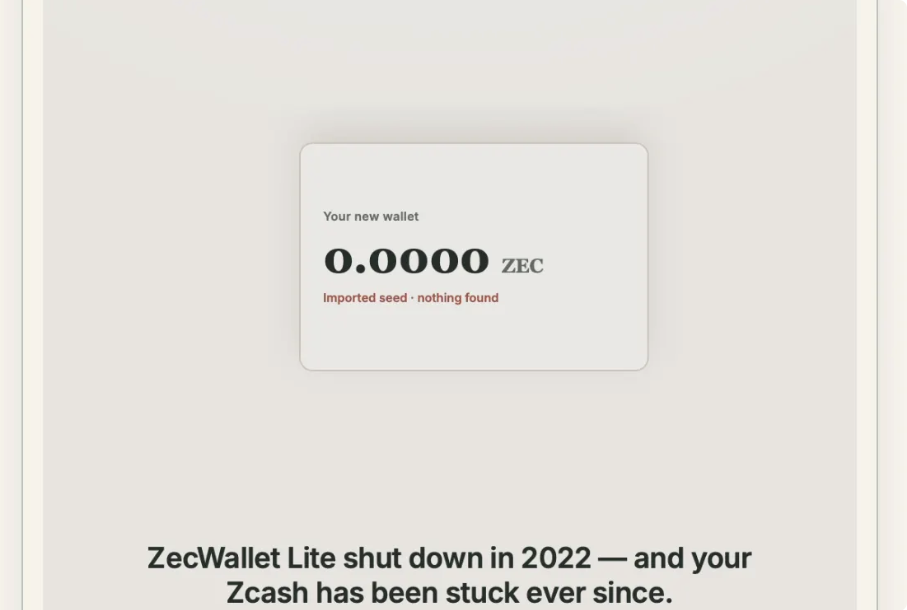
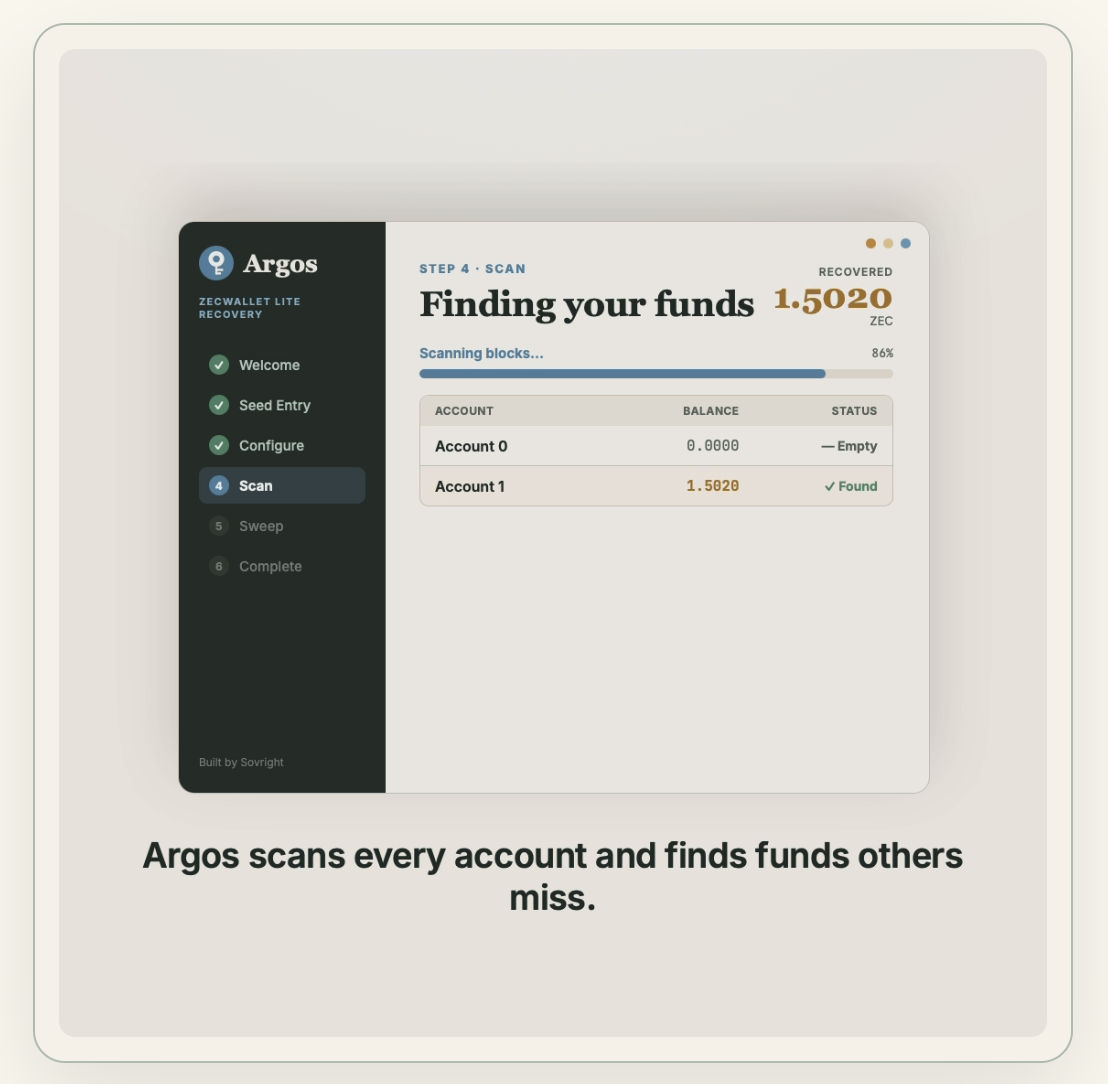
This tool called Argos helps people with stuck Zcash. If you stored funds in ZecWallet Lite, a wallet that is no longer maintained, and you can’t move those funds anymore, this recovery tool is built to get you access again.
If you’re one of the people who needs Argos, a quick tutorial:
1. Download the desktop app from the official Argos site at argos.sovright.com
2. Click “I have my 24-word seed phrase”
3. Enter the seed, and click validate seed. If it says “Seed phrase is valid,” click continue.
Note: only the local app gets your seed. It is never uploaded to the Sovright website. Validation happens locally against the BIP-39 checksum. The site itself never sees the seed, and the field clears after the scan starts. If anyone messages you asking for that seed “to help recover your funds,” they are scamming you.
4. Under “birthday block height,” write the birthday (or an estimate of when the wallet was created)
5. Under “server preset,” click “use current server”
6. Under “zcash node address (lightwalletd),” write your selected servers. Here are three you can write in, separated by commas:
https://zec.rocks:443,https://zec-node.cakewallet.com:443,https://na.zec.rocks:4437. Under “destination address,” type the address you want your recovered funds sent to. I personally like the ZODL wallet for Zcash.
8. Click “start scan.” This may take minutes or days depending on how old your wallet is.
Note: You can stop the scan at any time by exiting, and when you re-enter you can start it again and it will resume where you left off.
9. When it’s done, click “sweep.” (To sweep means to empty that wallet and move the funds into a new one.) This step is irreversible. Afterward, treat the old seed as burned and don’t reuse it.
I’m super grateful to the Sovright team for building this tool. I personally know many people who got funds stuck in unmaintained software, and when I mentioned the issue to the Sovright team, they decided to build something that would help.
The entire privacy coin ecosystem is a great example of small scrappy teams doing unglamorous work that keeps the ecosystem actually usable. The ZODL team have done many all-nighters patching issues for users and shipping a great wallet you can even use to buy your Chipotle with. Boston Zcash regularly hosts community meetups if you want to dive into the technicals, such as an upcoming event in collaboration with Shielded Labs and Zooko to talk about the latest upgrades.
When the tools break, and when the surveillance gets worse than ever, there are some amazing teams showing up to build the lifeboats. My hat goes off to all of them.
What it means is that it doesn’t have to be quite so scary to poke around in this world anymore. Whether you want to fix things yourself or pay experts, you’re not alone anymore. Bookmark this. Forward it to the one person in your life who’s been sitting on a seed phrase they’re too scared to touch.
Yours In Privacy,
Naomi
Consider supporting our nonprofit so that we can fund more research into the surveillance baked into our everyday tech. We want to educate as many people as possible about what’s going on, and help write a better future. Visit LudlowInstitute.org/donate to set up a monthly, tax-deductible donation.
NBTV. Because Privacy Matters.